

By the time they launched Pure Genesis in 2018, Faye Coleman and Priscilla Wynn had already built successful careers in fields that had little to do with cannabis. Coleman was a veteran of the operations world—having held senior roles at Kraft, Campbell Soup, CVS, and Target. Wynn worked in information technology, navigating systems, logistics, and compliance long before seed-to-sale tracking was a cannabis buzzword.
But both women were looking for more.
“We’d done well in corporate America,” Coleman said. “But we started asking: What does building something for yourself really look like? Not just climbing someone else’s ladder—but creating your own.”
They weren’t entering the cannabis space as insiders or legacy growers. They were professionals—with real skills, real losses, and a sense that the industry could be something different if they helped shape it.
Loss, Legacy, and the Long View
For Coleman, that sense of purpose began at home. As a child, she watched her mother suffer through the harshest realities of breast cancer treatment.
“She lost seventy pounds on a five-foot frame,” she said. “Her skin turned cold black. Her mind was never the same.”
At the time, cannabis wasn’t even a conversation. But looking back, Coleman believes it could have offered real relief. Appetite support. Sleep. Sanity.
Then, a week after her mother passed away, Coleman herself was diagnosed with breast cancer.
“I had always believed in alternative medicine,” she said. “But now it wasn’t theoretical. It was personal.”
For both Coleman and Wynn, Pure Genesis became a way to move forward—professionally, yes, but also generationally. The business they built had to support their families, their health, and their communities.
A Company With Many Branches
From the start, Pure Genesis was built to be adaptable. It began with education and consulting, then expanded into cultivation. They’ve grown hemp in New Jersey, Pennsylvania, and South Carolina, and even launched a hemp farm in Senegal. Along the way, they secured a license in New Jersey and formed partnerships in New York and Florida.
Their latest chapter includes a retail storefront—Genesis Dispensary—slated to open in Atlantic City later this year. Upstairs will be a consumption lounge with music, live events, and wellness offerings like CBD facials and yoga. It’s a concept Coleman and Wynn say they’ve been waiting to see in the U.S.
“In Amsterdam, it’s not weird to have coffee, conversation, and cannabis in the same place,” Coleman said. “Why not here?”
The 8,000-square-foot facility will be directly across from the Hard Rock Hotel. If it succeeds, it may become one of the East Coast’s most prominent examples of consumption culture done with care.
Whoopi, Wellness, and the Drink That Tastes Good
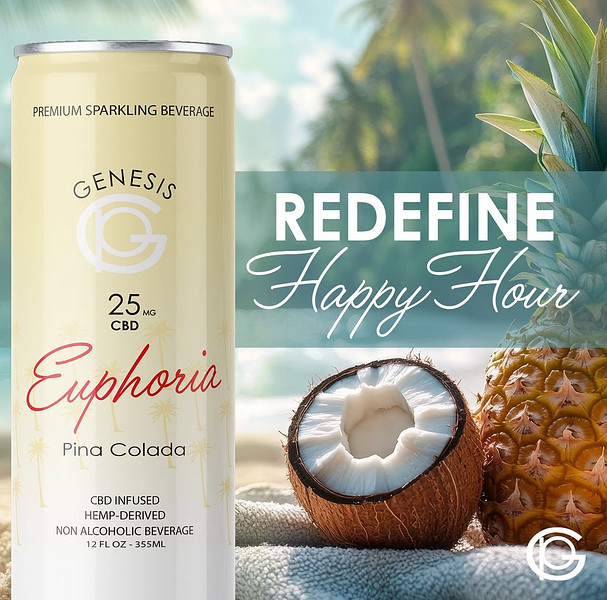
Their most high-profile venture, however, came through an unexpected connection. Whoopi Goldberg was looking to collaborate with Black women in cannabis—entrepreneurs who not only shared her values but could handle the weight of a national product rollout.
She was introduced to Coleman and Wynn. The partnership felt right.
“Once we met, it was a great connection,” Wynn said.
“She tells it like it is,” Coleman added. “And she made it clear—she wanted partners with strong leadership, not just good intentions. We aligned on purpose: products that don’t just make you feel good, but that make you feel better.”
Together, they launched Whoop-Tea, a hemp-derived beverage designed as a low-barrier entry point for consumers curious about cannabinoids but unsure where to start.
“We looked at everything—from edibles to tinctures—but the beverage space made the most sense,” Wynn said. “It’s familiar. It doesn’t intimidate people.”
And it had to taste good.
“There are a lot of hemp drinks on the market,” Coleman said. “But many of them need to be mixed or masked. Ours doesn’t. You can pour it over ice and enjoy it as-is.”
According to their market research, 97% of respondents agreed.
Hard Numbers, Harder Truths
Despite their progress, funding remains a challenge—and a clear example of what hasn’t changed in cannabis.
“There are 14 million women-owned businesses in the U.S. That’s $2.7 trillion in revenue,” Coleman said. “And yet we’re still asked to prove ourselves every time.”
She cites another stat: 80% of new women-owned businesses are started by women of color. “We are bankable. But the investment isn’t intentional.”
They’ve had both positive and negative experiences with funders—some supportive, others opportunistic. The lesson, they say, is to stay grounded and build smart.
That’s where Wynn’s background in IT plays a central role. From logistics to inventory to compliance, she manages the systems that keep Pure Genesis running. And she sees technology as central to cannabis’s next phase.
“AI can help streamline operations. Crypto could eventually ease payment and banking issues,” she said. “There’s a lot of inefficiency that tech can solve, if we’re willing to use it.”
Know Your Why
Amid the expansion—products, stores, partnerships—Coleman and Wynn return often to the same framework. They call it the “five whys.”
Why this industry? Why this state? Why this location? Why this team? Why me?
“It’s not an easy business,” Coleman said. “You have to ask yourself those questions early and often, or you’ll lose track of what you’re building.”
For them, the answers are clear. They’re not here because it was trendy. They’re here because the work is personal—and because building a cannabis company that reflects their values was never optional. It was overdue.