
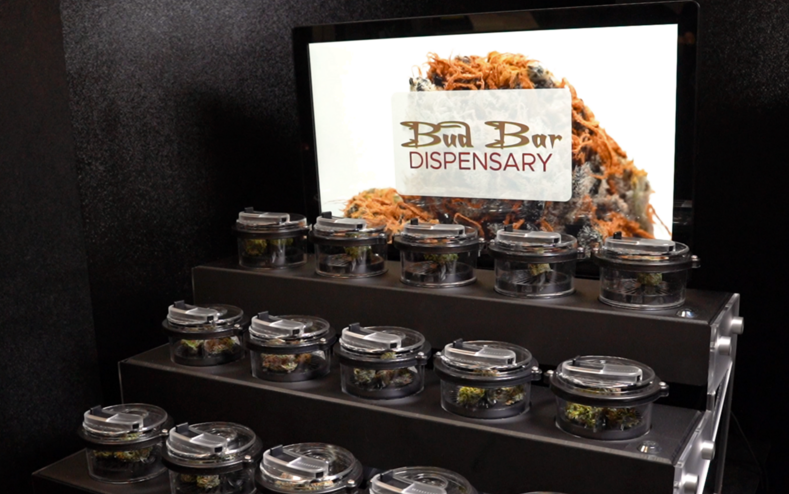
Walk into a well-designed dispensary today and you’re as likely to find glass, light, and polished surfaces as you are strains of flower and terpene charts. Cannabis retail has transformed into a study in sensory curation evolving from the dimly lit rooms that defined the early medical era.
Bud Bar Displays sits squarely within that transformation. Founded by Will Smith and his team at All Plastic, Inc., the company adapted display design to the unique challenges of cannabis: compliance, hygiene, and customer education.
“It was like the Wild West of cannabis,” Smith recalled of the California medical scene. “The original designs were focused on sampling cannabis in a hygienic way, which is still the main goal when we approach new designs today.”
The idea that consumers should experience the product up close, without compromising safety or compliance, helped redefine how dispensaries think about the retail floor.
The Hygiene Problem and the Rise of Sampling
In the early 2000s, many dispensaries used a simple approach that consisted of glass jars and shared smells. Customers leaned in, sometimes inches from the flower, while others later purchased from the same container. It was experiential, but not exactly sanitary.
Smith’s solution was both practical and visionary. He designed a sealed pod that allowed customers to view and smell cannabis through a controlled airflow system. The design became the foundation for Bud Bar’s now-patented “Container for Providing Aromatic Sampling and Visualization of Contents.”
“I wanted to develop a product that would allow consumers to experience the product as close as possible in a hygienic way while meeting various regulatory requirements,” Smith explained. “That’s what it’s all about: engaging and educating people about how cannabis can have a positive impact on their lives.”
The approach not only solved a health and safety issue, but also gave dispensaries a tool to elevate presentation and trust. When cannabis came out from behind the counter, the customer became an active participant in the buying process, representing a subtle but significant shift in retail psychology.
Lessons in Intellectual Property and Industry Maturity
Bud Bar’s journey also offers a revealing look into the growing pains of the ancillary cannabis market. In 2022, the company settled a patent infringement case over its sampling pod technology. The dispute underscored both the value of innovation and the risks of imitation in an industry still finding its legal footing.
“Our biggest takeaway from this experience is the frightening potential to have years of hard work and investment lost because someone swoops in and copies an already successful product,” Smith said.
That kind of IP enforcement is rare in cannabis, where growth often outpaces regulation. Yet Bud Bar’s decision to pursue legal protection reflects a broader trend: as the industry matures, so too does its infrastructure. Design, compliance, and branding are becoming as defensible and valuable as the products themselves.
The Science of Display
Research in retail psychology has long shown that presentation affects purchasing. In the cannabis space, where customers rely on visual and olfactory cues to assess quality, the impact is even greater. A well-lit, accessible display showcases the product while signaling transparency and professionalism.
Bud Bar’s 30-year background in plastic fabrication through All Plastic, Inc. positioned it to meet that demand. The company’s products are functional tools, but also silent educators, helping customers distinguish between strains, terpenes, and trichome structures.
“Many people don’t realize how much a well-designed and branded display helps sell more products,” Smith noted. “With 30+ years of innovation and fabrication experience, we know how to consistently develop and produce high-quality products that attract, engage, and educate customers.”
Dispensary operators, increasingly competing on atmosphere and experience beyond product availability, have taken notice. Across North America, design-forward cannabis stores are adopting museum-like layouts, using display systems not unlike Bud Bar’s to encourage curiosity and dialogue.
Digital and Interactive Futures
Retail presentation is entering another phase—one driven by technology. Bud Bar’s latest innovation, Cann-O-Vision, combines physical sampling pods with digital displays that provide strain details, terpene maps, and video content.
“Informed customers make better buying decisions,” said Smith. “They’re more satisfied with their purchases and are much more likely to become repeat customers.”
The move toward interactivity parallels developments in other retail sectors, from cosmetics to craft spirits. As the cannabis consumer base diversifies, the shopping experience must do more to educate and entertain. Cann-O-Vision, in that sense, is a signpost pointing to a future where retail spaces double as classrooms and brand theaters.
A Case Study in Design Thinking
Bud Bar Displays is a microcosm of how cannabis retail has professionalized. From its roots in solving a hygiene problem to its present emphasis on interactivity and education, the company illustrates how ancillary innovation shapes broader industry trends.