
Joseph Edwards possesses an intimate knowledge of cannabis cultivation’s perils. As chief science officer at Deconix, formerly Yofumo Technologies, he has witnessed harvests ravaged by invisible foes: yeast, mold, bacteria and the insidious Aspergillus. Beyond compliance, these contaminants imperil not only compliance but the very essence of the plant, compromising terpenes, cannabinoids and aromatic profile. Edwards’s solution eschews brute force for subtlety. His company’s ozone-based systems deliver microbial annihilation through measured exposure, preserving the flower’s intrinsic value.
The cannabis industry grapples with microbial bioburden amid fragmented regulations. States like Illinois and New York enforce rigorous limits, while others, such as Oregon until recently, maintained laxer standards. Internationally, the European Union’s GMP framework looms as the gold standard. Failed tests force destruction or downgrading to low-margin extracts, erasing weeks of labor and capital. Deconix addresses this exigency with technology born from necessity.
From Soil to Strategy
Edwards joined Deconix’s founding team in 2016. A biochemist and engineer, he had already cycled through every station in cannabis production: laborer, trimmer, cultivation manager, facility owner.

“I’ve worn all hats at various points in time,” he told Cannabis & Tech Today during a wide-ranging interview. “It’s given me a really unique perspective.”
The company’s genesis traced to a simple question: how do you sterilize biomass without sterilizing its value? Early experiments with radiation and high-concentration ozone revealed unacceptable trade-offs. Volatile compounds evaporated. Terpene profiles flattened. Cannabinoid potency dipped. Aspergillus, the industry’s nemesis, proved especially resilient. Exposed to aggressive ozone floods, the fungus enters “metabolic inertness,” a hibernation state that shrugs off annihilation.
Deconix pivoted. Partnering with Atlantic Ultraviolet, engineers developed custom generators that emit ozone in micro-doses—parts per million.
“We started looking at the resiliency of these cellular structures,” Edwards explained. “The plant molecular structures have a higher natural resilience than the microbes we’re looking to treat.”
The breakthrough was philosophical as much as technical. “We don’t balance product quality whatsoever,” Edwards declared. “Why spend 15 weeks, why spend that money, that labor at capital to really develop a product that you have to destroy to bring it to market? That was really never a feasible solution.”
Death by Slow Poison
Deconix’s protocol administers ozone gradually, a strategy Edwards calls “death by slow poison.” Rather than hammering pathogens into submission, the system starves them of metabolic refuge. Aspergillus cannot retreat into dormancy when the assault arrives in whispers. Over hours, not minutes, the gas penetrates trichomes, bracts and stems, achieving log reductions across yeast, mold, coliforms and viruses.
“For us, for Aspergillus specifically, it is more of a death by slow poison than it is hitting it with a hammer,” Edwards said. The metaphor captures the elegance: lethality without collateral damage.
Independent labs validate the claims. UL, CE and GMP certifications affirm no harmful residues remain. The flower emerges compliant, aromatic and potent. One client reported salvaging 400 pounds of premium cultivar that had tested at 1.2 million CFU/g total yeast and mold. These numbers would have triggered mandatory destruction in most jurisdictions.
Modular Might
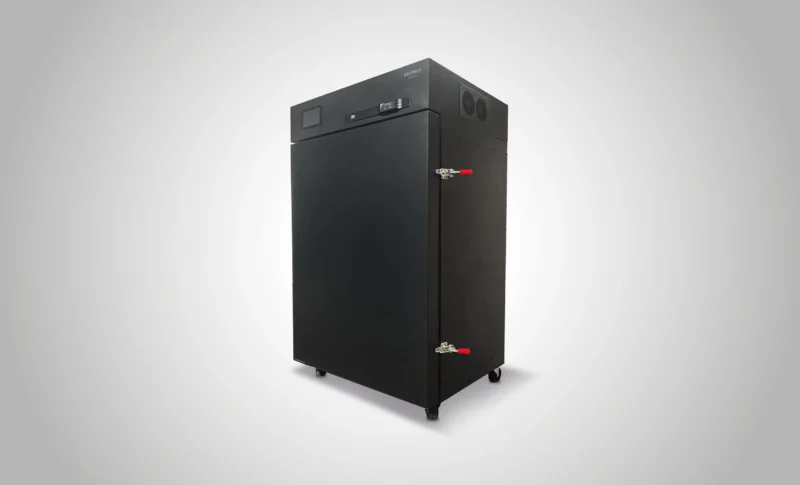
Deconix systems defy the stereotype of industrial behemoths. Each unit runs on standard 110-volt power, draws 4.5 amps at peak and fits through a 32-inch doorframe. “Your toaster is less power efficient,” Edwards quipped. Operators bank units like Lego bricks to scale throughput from 20 pounds per cycle to tons per day.
This modularity democratizes access. Boutique growers in Humboldt County deploy a single chamber. Multi-state operators in Oklahoma stack dozens. No three-phase power, no concrete pads, no chillers required. The footprint accommodates legacy facilities and greenfield builds alike.
White Glove Integration
Hardware alone does not win compliance. Deconix deploys technicians for comprehensive facility audits. They dissect SOPs, map post-harvest workflows and analyze historical COAs. The goal: insert decontamination at the precise inflection point where bioburden spikes.
“We go out onsite, we do a full facility evaluation, we meet with the team, we look at your process line,” Edwards said.
For one Midwest cultivator, treatment post-principal dry slashed yeast counts from 800,000 CFU/g to below detectable limits. Another, with intermittent Aspergillus fails, scheduled final sanitization 48 hours before packaging. The difference: one client prevented proliferation; the other insured against late-stage contamination.
This concierge model extends to regulatory foresight. Deconix exceeds the strictest benchmarks, EU Pharmacopoeia 5.1.8 B and C, ensuring equipment remains viable as standards tighten.
“We’ve always tried to plow the biggest field first,” Edwards noted. “What’s the hardest, most stringent set of standards we could possibly hold ourselves to? And then let’s put a little bit more on top.”
Global Ambitions
Europe beckons. Germany’s phased medical rollout, Portugal’s export hubs and Switzerland’s pilot programs signal a continent coalescing around unified GMP. Unlike America’s state-by-state patchwork, the EU permits interstate commerce. Product grown in Lisbon can ship to Berlin without retesting.
Deconix positions itself as infrastructure. Units already operate in South Africa and Thailand. European clients receive turnkey compliance: stainless-steel construction, no-touch interfaces and digital run reports that satisfy ISO-grade cleanroom protocols.
“They’ve learned a lot of the lessons from US and Canada,” Edwards observed. “Once it does [launch], it’ll be a train that just doesn’t stop.”
Seeds of Tomorrow
Cannabis is merely the proving ground. In 2019, Deconix collaborated with agronomists in Spain’s Almería “sea of plastic”, a 100-square-kilometer expanse of hydroponic greenhouses. Researchers sought to curb post-harvest losses approaching 60%. Ozone treatment of vegetable seeds yielded an unexpected dividend: germination rates rose 18 percent, crop uniformity improved and Fusarium oxysporum vanished.
“We were looking at decontamination of the seed, essentially inoculation prior to planting,” Edwards recalled. “The seeds that we treated also had a more even rate and a higher germination rate.”
Budget constraints shelved follow-up, but the data endure. Deconix now courts heirloom seed producers and vertical farms to resurrect the trials.
Closer to home, software evolves. Future interfaces will ingest COA data directly, auto-calibrating treatment parameters and eliminating transcription errors. In GMP environments, where human touch is taboo, such automation is non-negotiable.
Also Read: 2025 Last Minute Stocking Stuffer Guide
Preservation Ethos
Deconix began in mom-and-pop grows rather than corporate boardrooms. “We were built by testing in small boutique rows in Midland producers,” Edwards reflected. “We worked our way up over years and years and years.” That origin story infuses every decision. The company could chase only MSOs, yet it refuses to abandon the artisans who nurtured the plant through prohibition.
“We were built out of that boutique idea that everything deserves to be preserved,” Edwards said. “There is a value in this, so why wouldn’t we absolutely do work with those boutique growers?”
In an industry maturing faster than its regulations, Deconix offers certainty. Pathogens will always lurk. Standards will always tighten. But with measured ozone and meticulous service, cultivators need not sacrifice quality for compliance. Edwards has proven the two are not adversaries but allies.