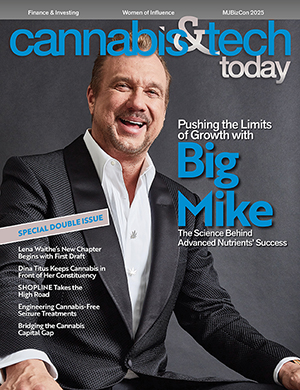

Few figures in cannabis embody both the visionary drive and technical rigor of Mike Straumietis, the founder of Advanced Nutrients. Known throughout the cultivation world as “BigMike,” he has spent more than two decades chasing a singular goal: unlocking the plant’s full genetic potential. From early tissue-sample experiments in the 1990s to today’s eighth-generation nutrient formulations, Straumietis has built his company on an unyielding belief that cannabis can and should be treated like any high-value agricultural crop.
When Cannabis & Tech Today caught up with him, Straumietis was in the thick of preparing for MJBizCon, where Advanced Nutrients remains a fixture on the expo floor. What followed was a deep, unfiltered conversation about the evolution of cannabis science, the breakthroughs that defined his career, and the future of cultivation — from digital genomes to cannabinoid-optimized genetics.

Cannabis & Tech Today: You’ve said growing cannabis has evolved from art to precise science. What moment defined that shift for you?
Mike Straumietis: It was 1999. I wondered if anyone was actually making these products for cannabis. So we started doing tissue samples from multiple strains every week, from veg through flowering, and worked with UBC and BCIT, which is basically the MIT of Canada.
We realized cannabis is very precise in what it wants at specific points in its growth cycle. There’s a real shift in the micronutrients between bloom and grow, and once we mapped that, we could get exact about feeding. Chelation technology is huge in that—having the right chelates of micronutrients makes all the difference.
When we hit the ceiling of what nutrients alone could do, I joined the Plant Growth Regulation Society of America. That’s where I started talking to PhDs from all over the world, the best minds in agricultural science. They had compounds and stimulants that were too expensive for mainstream agriculture but perfect for cannabis. That changed everything.
We’re now on our eighth generation of formulations. It blows away the seventh. It took three years and more than three million dollars in research. We’re already working on the ninth and gearing up for the tenth. The tenth is something entirely new, the next wave in agricultural science, and we’re already applying it to cannabis.
C&T Today: The pH Perfect line is famous for its automatic stabilization. What inspired that development?
Straumietis: Consistency. You can’t have a formula that shifts depending on the environment or the user. We ran thousands of trials in hydro, coco, and soil to make sure it worked in every system. We needed something so reliable that even if a grower made small mistakes, the plant would still thrive. That’s the beauty of pH Perfect—it’s forgiving and helps people learn.
C&T Today: Speaking of home growers, what’s your take on that movement?
Straumietis: It’s the next big thing. More tomatoes are grown at home than bought in stores. If that holds true for cannabis, millions of people are going to grow. You’ve got autoflowers now—just plant and go. The law might allow three or six plants, but that’s enough for personal harvests. Everyone should have the right to grow.
People love showing off their gardens online. Once more states allow it, you’ll see cannabis growing next to tomatoes and peppers. It’s part of the same backyard revolution.
C&T Today: Your new SB1 additive uses nano-carb and phyto technologies to enhance terpenes and resin. How does it work?
Straumietis: Some of that’s proprietary, but I can tell you part of it is a sugarcane extract fermented in a very specific way that gives us an edge. It’s like rocket fuel. Growers using SB1 are seeing close to six percent terpenes, higher cannabinoids, and better harvest weights. It’s part of the eighth generation of products—a whole new technology platform for cannabis.
C&T Today: You mentioned the next generation is already underway. What makes the ninth and tenth so different?
Straumietis: The ninth generation is an optimization of what we already have. The tenth is a completely new platform being discovered in mainstream agriculture right now. It hasn’t been applied to cannabis yet, but it will be. It’s extremely difficult and expensive, but we’ll do it.
C&T Today: Let’s talk about your Cultivator Series. You’ve said it’s the only three-part water-soluble line that meets cannabis’s phase-specific needs. How does that translate to yield and potency?
Straumietis: When you give the plant exactly what it wants, it thrives. People forget the chemistry. There are anions and cations. If you give too many anions, the plant exudes an alkaline substance that harms the rhizosphere. We’re heavy on cations, which keeps it acidic and stable.
We also learned cannabis uses a lot of iron—almost like a secondary nutrient. In veg, it wants more calcium, iron, manganese, and boron. In bloom, it wants more nitrogen, potassium, phosphorus, and zinc. The calcium demand drops in bloom.
Cannabis is an accumulator plant. It will absorb anything, good or bad. So you have to be careful. And here’s a big myth: cannabis doesn’t need as much phosphorus as people think. Universities are now backing what we published twenty years ago—the “phosphorus myth.” Companies overuse phosphate because there’s a surplus of it globally, but too much actually limits yield.
If you go to the phosphate mines in Morocco, they’re pumping it into the ground like crazy. But the plant doesn’t use it all, and it ends up hurting its ability to produce.
C&T Today: Is overfeeding still the most common mistake?
Straumietis: Absolutely. People think more is better, but it’s not. Precision beats excess. If you’re an athlete, you don’t just overload on one macronutrient. Plants are the same. Give them balance and timing, and they’ll reward you with consistency.
C&T Today: Education has always been part of your mission. Tell us about your new initiatives.
Straumietis: The biggest Achilles’ heel in this industry is the lack of standardized training for cultivators. That’s why we released the War Room: Elite Cultivation Tactics book. It’s state-of-the-art. It covers under-canopy lighting, future trends, and everything a grower needs to know.
Our ACT Team wrote it. These are top-tier cultivators who grew up on Advanced Nutrients, went on to direct major facilities, and came back to share their knowledge.
We’re also partnering with Green Flower to create certification programs through fifty colleges across America. That’s the next generation, giving people the tools to grow professionally and profitably.
C&T Today: How do you see formal education changing as cannabis becomes mainstream?
Straumietis: You’ll see more ag students going directly into cannabis instead of traditional crops. The stigma is fading. They already think like scientists, which is what the industry needs, people trained from day one to grow efficiently and sustainably.
C&T Today: What about the workforce itself—legacy growers versus newcomers?
Straumietis: A lot of folks came from the underground. They’re hyper-independent, not used to structure. Then you’ve got new grads from agriculture programs—open-minded, eager to learn. When you train them right, they adapt fast.
I was one of those independent guys. I felt like I was part of the world but not of it. I didn’t follow all the rules, but I paid my taxes and built something real. Cannabis attracts that kind of spirit.
C&T Today: Advanced Nutrients has expanded into Europe and beyond. How do you maintain consistency across diverse regulations?
Straumietis: Europe’s about five to seven years behind North America, but it’s catching up. All our products are registered there. We go in early and talk to people before anyone else does. We’ve already been to the Middle East, we’re discussing a manufacturing facility in Thailand, and we’re in talks across Asia and South America.
When the U.S. moves from Schedule I to Schedule III, it’ll open the floodgates. Countries like Kazakhstan, Japan, South Korea, and Malaysia are watching. Once America moves, the rest of the world follows.
C&T Today: What’s your strategy in new markets?
Straumietis: It’s always education first. We meet with regulators, scientists, and growers. Every region has different compliance needs, so we adapt our formulas. We don’t just sell products; we help build infrastructure. That’s what makes it sustainable long-term.
C&T Today: How does sustainability factor into your product development?
Straumietis: Sustainability isn’t about slogans. It’s about economics. When you dial in genetics and nutrient delivery, you’re not just improving yield—you’re cutting waste. The right inputs mean less runoff, less energy, and more efficiency per watt.
Smarter formulations already let cultivators produce more with fewer resources. In a market where margins are thin, that matters more than ever.
C&T Today: How is Advanced Nutrients helping growers produce more with less?
Straumietis: Genetics is the next big frontier. We’re working on tetraploids and octoploids—the same principles companies like Driscoll’s use for massive blackberries. With these, we can create triploids: sterile, high-yield plants that resist disease.
Growers using our genetics are already getting up to 5.88 pounds per light. We know a six-pound light is possible. Cannabinoid and terpene profiles go up, and when you make hash, you earn about a thousand dollars more per light.
One reason is trichome membrane strength. Competitors’ membranes are thin, so they lose their aroma after a few weeks. Ours stay thicker, preserving terpenes and smell months later.
C&T Today: Do you see genetics as the key to long-term sustainability?
Straumietis: Absolutely. The right genetics require fewer resources and less intervention. A plant bred for stability and density uses less light and water. When you combine that with precise nutrients, it’s a game changer.
C&T Today: What’s the next frontier in cannabis science?
Straumietis: Digital integration. Someday soon, you’ll be able to sequence your plant’s genome, feed that data into a system, and it’ll tell you exactly how to grow it. We’re working on that now.
Someone is going to digitally organize the cannabis supply chain. You’ll scan your plant’s genome, upload it, and get a full cultivation roadmap. That’s where the future is heading.
C&T Today: What technologies will make that possible?
Straumietis: AI and automation. Imagine sensors talking to nutrients, which talk to irrigation and lighting, all adjusting in real time to what the plant needs. You’ll have a digital twin of your grow that predicts stress and adjusts conditions before problems start. It’s coming faster than most people realize.
C&T Today: You’ve called cannabis a trillion-dollar industry in the making. What drives that confidence?
Straumietis: Look at the beverage industry. Beer companies are losing fifteen to twenty percent of their market to cannabis. At the end of the day, it comes down to two molecules—alcohol and THC. People tend to prefer THC. It’s safer, it doesn’t kill people, and you can drive on it.
They say hemp is a fifty-billion-dollar side of the industry, and THC is thirty billion. That’s wild. Once the beverage companies fully enter, everything changes. You’ll have interstate commerce, then international commerce. States like California and Michigan will lead the way.
C&T Today: Any final thoughts on where cannabis is heading?
Straumietis: The future of cannabis is fascinating. I’m excited about where we’re at and where we’re going. This industry is evolving faster than any crop in history, and we’re not done yet.
A Plant Without Limits
Straumietis and his team are sketching the blueprint for the next era of agriculture. His work at Advanced Nutrients covers everything from biology to data science and entrepreneurship. Whether through optimized genetics, digital cultivation mapping, or next-generation bio-stimulants, his mission remains constant: to push the plant further.