
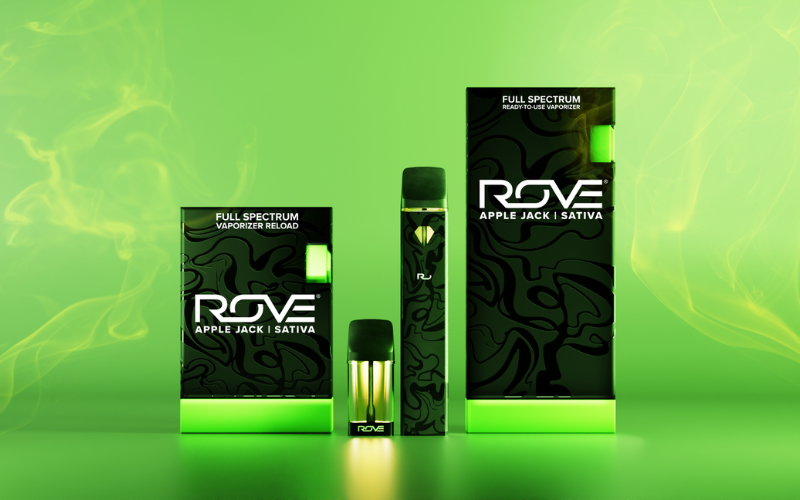
When Chris Marroquin moved from Nevada to California in 2020, he stepped into the hub of American cannabis. California’s crowded marketplace, fractured into countless niches, was a stark contrast to Nevada’s tight-knit scene. Yet it was the perfect place for Rove, a brand that started with vape cartridges in 2016 and has since expanded into 16 states, from California and New York to Michigan and Missouri.
“Here in California, it seems like it’s so vast that it seems like there are industries within the industry,” said Marroquin, Rove’s Director of Manufacturing. “Whether it’s processors or really equipment manufacturers, it’s really a hub and it’s a great community.”
Rove’s growth strategy is equal parts formula and flexibility. Each new state offers a different regulatory maze; packaging rules in one, potency caps in another.
“We definitely have a formula where we can go in and replicate what we’ve done in other states while also facing those challenges,” Marroquin said. “That’s the rewarding part about it.”
The company’s next frontier is Colorado, a market Marroquin describes as eager for premium products. For Rove, the move offers the ability to scale while still testing what consumers want next.
CO2 and the “Secret Sauce”
Extraction is where science drives Rove’s innovation. The company relies heavily on CO2 extraction for its efficiency and the unique terpene fractions it delivers.
“CO2 extracted terpenes are going to be vastly different than, let’s say, a hydrocarbon extracted terpene or even water-extracted terpenes from rosin,” Marroquin explained. He compared the process to a washing machine: plant biomass goes into a column, and instead of soap and water, pressurized CO2 gently strips away oils.
Because CO2 parameters can be dialed in with precision, Rove isolates exactly what it wants whether it be terpenes, crude oil, or fats. For Marroquin, the target is always terpenes.
“That’s what I consider our secret sauce in our product,” he said. “When you’re tasting a flavor profile, it’s not going to be one note or even a single note. It’s going to have a start, a middle, a finish, and a lingering taste as well.”
This layered experience is what keeps Rove’s cartridges from feeling generic. In an industry where consumers can choose from hundreds of nearly identical options, that difference matters.
Live Resin and Flash Freeze
If CO2 extraction provides consistency, flash-freeze technology gives Rove variety. The company produces live resin by cutting plants at peak ripeness and freezing them immediately, often within 24 hours.
“Conventionally, you would chop flower and then dry and cure it,” Marroquin said. “When that happens, some terpenes convert, some oxidize. With live resin, you’re really capturing that profile at its peak ripeness.”
He likened the difference to eating a fresh banana versus banana chips. Both are valid, but offer vastly different experiences. By preserving esters, isomers, and delicate monoterpenes that often degrade during curing, Rove can offer products that feel alive, with profiles closer to the plant in its natural state.
Data, Palates, and Product Cycles
Rove’s product development leans heavily on consumer data and feedback. Regional patterns emerge in the numbers: East Coast customers lean toward sativas, while the West and Midwest prefer indicas. These insights guide new launches and signal when to retire a profile.
“If we start seeing sell-through go down significantly, we know that something’s amiss or that there’s a little bit of fatigue behind that profile,” Marroquin said. Focus groups further refine decisions, helping tailor products to demographics across the country.
The process recently led to the launch of Strawberry Cough, a crowd favorite rooted in consumer demand. “One thing that’s resounding is if one market really, really likes a certain profile, it tends to transfer over nationwide,” Marroquin said.
Terpenes Beyond Flavor
Cannabis science has advanced by leaps and bounds in the past decade, particularly in the understanding of terpenes. For example, researchers have found that beyond flavor, terpenes are biological keys that may influence absorption, potency, and even duration of effect.
Marroquin compared terpene infusion to dietary supplements.
“Say curcumin, which is the active compound in turmeric. A lot of people consume curcumin supplements, but in order for it to be absorbed, it might have pepper extract in there. Same thing with cannabis—terpenes help either the absorption of THC, help bridge the blood-brain barrier. I definitely think adding terpenes can make a more holistic product overall.”
Research is still catching up, but Marroquin is confident science will validate what consumers already feel.
“Some of those terpenes actually help flush out the receptors from THC that isn’t active anymore, and it allows you to receive fresh THC into those receptors to really have a more pronounced effect,” he said.
Fighting Counterfeits with QR Codes
As Rove grew, counterfeit products flooded the market. Some were so convincing they appeared on mainstream media.
“There was a time where there was a website set up that was selling our profiles,” Marroquin recalled. “We ordered some and they weren’t anywhere near what they claimed.”
To combat knockoffs, Rove introduced QR authentication, giving each unit a unique, verifiable code.
“Every single unit has a unique barcode,” Marroquin said. “It was somewhat challenging on the production side, but it was definitely worth it because we saw counterfeits diminish substantially.”
The system also lets consumers access rewards while confirming authenticity. According to Marroquin, the effort safeguards the first impression of new customers. “It’s important for us to make sure that whoever’s trying Rove for the first time is actually trying what we try.”
Innovation as Survival
Cannabis extraction has traveled far from the clandestine basements of the 1990s. Today, CO2 systems rival pharmaceutical labs, flash-freeze freezers preserve molecular subtleties, and terpenes are studied with the seriousness once reserved for wine tannins.
Rove sits at the center of this transition, blending manufacturing rigor with consumer curiosity. The company’s expansion is as much about spreading a brand as it is about pushing the boundaries of what cannabis can be.
“Legalization has really opened up that path to start really understanding the plant a little bit better,” Marroquin said. “It’s just that evolution, the innovation—and really, the more people know, the better for the industry.”